Granola: the end of the notetaker as a product
Wispr Flow's support desk confirmed the unannounced Notetaker rollout, then told me to keep paying Granola. Here is why I think they're wrong about the second part.
Hey!
My name is Lambert, and I run growth at Kai, which competes with every product in this article. Read me with that in mind.
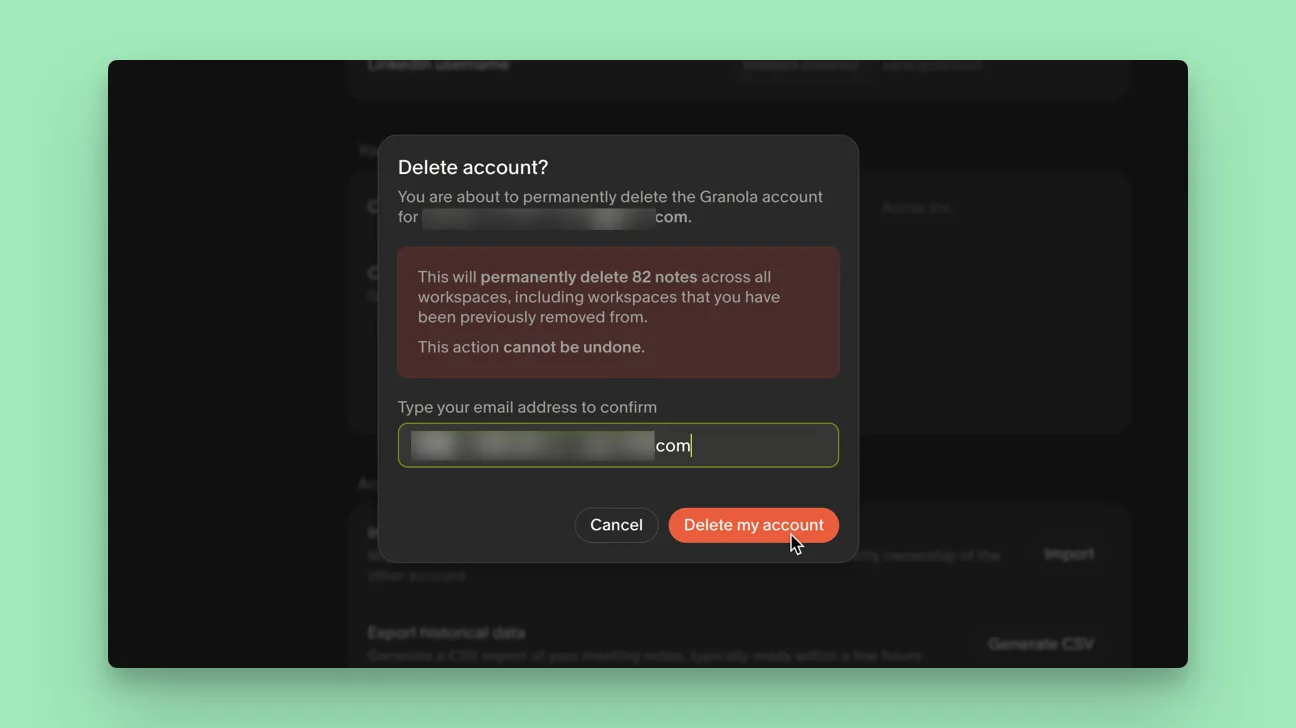
I used Granola for more than a year. Eighty-two notes’ worth, which is the number on that screen up there. It changed how I sit in a call: I stopped trying to type everything down, jotted three lines instead, and got back something better than what I would have written myself. For a long stretch it was the first name I gave whenever someone asked which AI subscription actually earns its place.
I stopped opening it about three months ago. Most of what follows is me working out why.
I’ve also built two of these things. A free meeting transcriber that runs entirely in your browser, where I hit seven walls in a single week and never got past two of them, and a Chrome extension that transcribes calls on the device because a web page physically cannot hear a native app. So I know where the bodies are buried: the audio the browser can’t capture, the model that’s too heavy to ask a stranger to download, the diarisation nobody gets right, the cloud transcription bill that turns a free tool into $1,365 a month.
Which is why the email I got back last week landed the way it did.
I’d written to Wispr Flow’s support desk with two questions. Why can’t I find the Notetaker tab in my app, and should I cancel Granola and switch.
The first answer confirmed a product Wispr has never announced. The second one told me to keep paying their competitor.
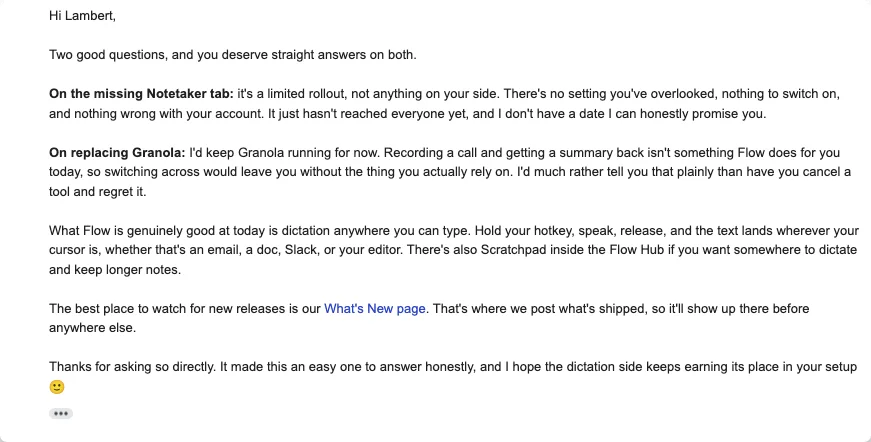
On the missing tab: “it’s a limited rollout, not anything on your side. There’s no setting you’ve overlooked, nothing to switch on, and nothing wrong with your account. It just hasn’t reached everyone yet, and I don’t have a date I can honestly promise you.”
On replacing Granola: “I’d keep Granola running for now. Recording a call and getting a summary back isn’t something Flow does for you today, so switching across would leave you without the thing you actually rely on. I’d much rather tell you that plainly than have you cancel a tool and regret it.”
I have a lot of time for that second answer. It’s also the best argument against everything I’m about to write, which is this: Granola spent two years owning one sentence, the notetaker that doesn’t send a bot into your meeting, and that sentence quietly stopped being theirs.
So yes, I think Granola is dead in its current form. Not this quarter. They raised a $125M Series C at a $1.5 billion valuation in March, they have years of polish on a product people genuinely love, and none of that evaporates because I wrote a title. But the thing that made Granola Granola is now something another company also does, and it happened without Granola putting a foot wrong.
Two reasons, then what it costs them, then what they’re already doing about it.
This article is for you if:
- You pay for a dictation app and a notetaker, and you’ve started wondering why that’s two bills
- You’re building in the meetings space and want the read before the announcement lands
- You want the receipts on an unannounced product rollout, including the email
Let’s go.
Reason 1: Wispr Flow shipped the same product
Wispr Flow has a Notetaker tab in its Mac app. It records your calls with no bot joining, transcribes them live with speaker labels, and turns them into summaries with next steps attached to actual people.
The support email is not the only trace. Their public changelog stops at formatted snippets and team leaderboards, and the pricing page doesn’t mention Notetaker at all. But the Terms of Service effective July 25 define it precisely: transcription, note-taking, summarization, speaker identification, action item generation and meeting insights, and they state that it “currently requires Cloud Sync to be enabled.” The privacy policy was updated the same day. Six help-center articles were edited between July 9 and July 21. The MDM guide already tells IT admins to pre-authorize system audio “for meeting notetaking.” The lawyers and the support desk both documented this product before the marketing team did.
We ran six real meetings through it on a Flow Pro account, and I wrote the full hands-on review on the Kai blog if you want every screenshot. Two things matter here.
The design is better than Granola’s. Not the product, the design, and the difference is the whole point of the support email. In Wispr, when the transcript doesn’t know who someone is, it labels them Speaker 1. You click the label, a modal replays two short quotes from that voice so you can recognize who it was, you type the name once, and the entire transcript relabels. The part I didn’t expect: the summary’s next steps update too. “(Speaker 4) Confirm the IP discrepancy” becomes a task with a person’s name on it. Granola’s speaker handling is a known weak point and has no equivalent. Same with pre-meeting briefings: connect your calendar and Wispr shows a card before the call with when you last spoke to this person, what they wanted, and what to expect this time. Granola’s calendar awareness lists your upcoming meetings.
It came from a direction nobody was watching. Wispr Flow was the app that replaces your keyboard. You press a hotkey, you talk, clean text appears wherever your cursor is. That’s the whole identity, and it’s a category away from meeting notes. Except a dictation app already has microphone permission, already has your speech model, already runs in the menu bar all day. Extending that to the meeting is a smaller step for Wispr than building dictation would be for Granola. The moat wasn’t the feature. The moat was supposed to be the habit, and Wispr already owned a bigger one.
Where the thesis is weakest
The support desk made the strongest case against me, and it isn’t alone. When I put the question to r/ProductivityApps, someone who builds their own dictation tool made the structural version of the same argument:
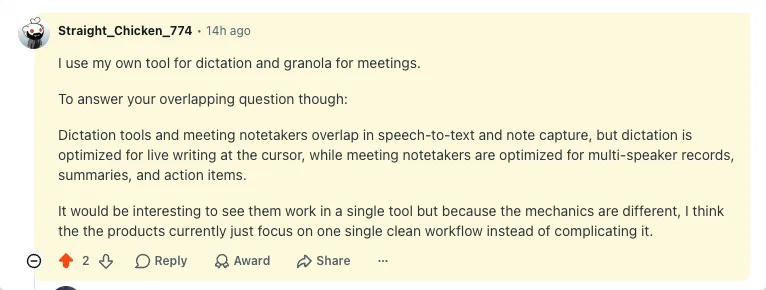
Dictation is one speaker, deliberate, seconds long, and the text has to land at your cursor, so latency is the entire product. A notetaker is multi-speaker, hours long, needs diarisation, and the output is a document you search later, where latency doesn’t matter. Different mechanics, so each product stays in its lane.
The current build backs that up. Jim ran Notetaker in a real stand-up and diarisation couldn’t tell two of our teammates apart. Transcript cleanup takes two to three minutes before the summary appears. Renaming speakers by hand took him three or four minutes for one meeting, which nobody repeats after every call, so most transcripts stay as Speaker 1, Speaker 2, Speaker 3. And that cleanup is a language model rewriting what you said, with no audio to check it against, since Wispr’s privacy policy says meeting audio isn’t replayable.
So the design is ahead and the build is behind. Both are true, and the gap between them is exactly what a support agent has to manage when a customer asks whether to cancel something. None of it is an argument about where this lands. Wispr already shipped the thing, unfinished, to a slice of its users, and wrote it into its terms of service. Granola wasn’t finished in 2023 either.
Reason 2: neither of them goes past the meeting
Here’s the part that isn’t about Wispr at all.
Granola ends when the meeting ends. You get a beautiful note. Then you’re on your own.
I want to be fair about the connectors, because “Granola has no integrations” is lazy and wrong. They have a Slack integration that posts note links to a channel, manually or by folder rule. They send notes to Notion. They match notes to the right person, company or deal in Attio, HubSpot and Affinity. Zapier covers 8,000 other apps. Their MCP server is available on every plan, including the free one, so you can query your notes, browse folders, search by date range and pull transcripts from Claude or ChatGPT. There’s an API on Business and Enterprise. That’s a real surface area, and more than most of their competitors ship.
Every single one of those is one-directional. The note goes out to a destination, or a model comes in to read it. Nothing acts. Not one of those connectors turns “Mariana follows up with Tuck on the switch replacement” into an assigned task with a due date in the system where Mariana actually works. The action item is captured, correctly attributed, and completely inert. Wispr hits the same wall from the other side, with fewer connectors and the same result.
Which is why this is a problem for the category and not just for Granola. A notetaker that only takes notes is a feature. Granola built the best one and priced it like a product, and that pricing is what the rest of this article is about.
Disclosed bias, since this is what I work on: the version I want is the one where that same line, Mariana and the switch replacement, leaves the meeting as an assigned task with a due date, and the follow-up email drafts itself knowing which thread it belongs to. That’s what we build Kai to do. The note isn’t the output. The note is the input.
What that costs Granola
The premise. Before asking what people would drop, I asked what they run. I posted the question on r/ProductivityApps: dictation only, notetaker only, or both. Every single person who answered said both. Wispr Flow with Granola, Wispr Flow with Plaud, Wispr Flow with a homemade Obsidian notetaker. Small sample, and several of them build a competing tool and said so upfront, which I’d normally treat as a warning. Here it cuts the other way: the people who know this category best have all landed on two subscriptions. One of them added a warning worth repeating, that people who use both often don’t file them as the same category and will under-report running two. Nobody under-reported.
The question. So if one of those two grows into the other, does anyone keep paying twice?
The method. I put that to 21 people who already use at least one of the two products, one at a time, with no list of options to pick from. Sixteen said they would run Wispr alone rather than carry two subscriptions. Three would keep both. Two would keep Granola and skip Wispr’s version.
Why 21 answers matter more than they should. Neither company publishes cross-usage data, and no panel measures dictation against notetaking as separate categories, so there is no public number to check this against. What exists, on one side only, is scale: Wispr reports roughly 2.5 million downloads. Granola has never published a user count at all. Putting a stated preference against a reported install base gives a range, not a fact, and the range is the point.
Sensitivity. The output is only as good as the weakest assumption, so here is the whole grid rather than the one number I like best. Rows vary the share of downloads that are weekly active users. Columns vary the share who would consolidate, from a deliberately pessimistic half up to the 76% I measured.
| Weekly active rate | At 50% consolidating | At 76% consolidating |
|---|---|---|
| 10% (250,000 users) | 125,000 | 190,000 |
| 15% (375,000 users) | 188,000 | 285,000 |
| 20% (500,000 users) | 250,000 | 380,000 |
| 30% (750,000 users) | 375,000 | 570,000 |
What this does not establish, including the part that undercuts my own framing. Those sixteen people did not choose Wispr. They refused to pay twice. I asked them about a notetaker that, by its own maker’s admission, doesn’t do meetings for you yet, so what I measured is an appetite for one subscription instead of two, and Wispr happens to be the one holding the bigger habit. Beyond that: 21 people is an anecdote with a denominator, and they’re people in my orbit, which skews toward early adopters who switch tools for sport. A stated preference is not a cancelled subscription. Downloads are installs, not humans, and Wispr’s figure is cumulative across platforms while Notetaker only runs on macOS 14.4 and up, so the reachable base is smaller than the top row of that table. And the denominator that would make any of this a market-share claim, Granola’s own user count, does not exist in public.
What survives all of that is the direction. Even the most pessimistic cell in the grid is a lot of seats to lose to a feature your competitor hasn’t announced. And the asymmetry is the real finding: Granola cannot run this calculation in reverse. Wispr can absorb the meeting because it already sits in the microphone all day. Granola cannot absorb dictation, because dictation means being the thing you press before you write a sentence, and that habit belongs to someone else.
So they change angle. Which is exactly what they’re doing.
On July 28, Granola shipped an Apple Watch app. One tap to record, a second tap to stop, audio syncs to your iPhone and comes back as structured notes. It’s free, it needs watchOS 11, and it can live on your watch face.
Read the positioning and it stops looking like a platform checkbox. They built it for meetings away from your laptop: whiteboard sessions, walking one-on-ones, advice over coffee. Chris Pedregal told TechCrunch the point is capturing an in-person conversation without pulling your phone out of your pocket. When they tested internally, a big chunk of their mobile usage moved from iOS to the Watch.
And on hardware, their line is precise: “the best wearable is one you’re likely to have already.” That’s a deliberate refusal of the pin and the pendant that several AI notetaker rivals shipped over the past year.
Then they made a hundred Apple Watch straps. Hand-woven by a London weaver, boxed by a printing house in Paris, sent to friends and power users, described as “a small reminder to stay present and follow the thread of the conversation.”
A software company with a $1.5 billion valuation just shipped a physical object. I don’t think that’s merch.
Here’s my hypothesis, and I’m labelling it as one because Granola has said nothing of the kind. I think the escape route is hardware, not more software. Not a phone app with more features, but physical objects that improve the quality of a conversation while it’s happening: capture that works in a room instead of on a call, positioned well enough to know who’s speaking, present enough that people stop performing for it. Software competitors can copy a summary format in a quarter. They cannot copy a supply chain.
Look at where everyone else is pointing. The whole category is fighting over the call: the Zoom link, the Meet tab, the audio your laptop can already hear. Granola just walked the other way, toward the conversations no software was ever invited to. I have those constantly. Someone tells me something over coffee that turns out to matter three weeks later, and there’s no link, no calendar entry, nothing to hang a summary on. That’s a real problem, and you don’t solve it with a better summary format.
That future already has customers, which is the detail that convinced me. One of the people who answered my Reddit post runs Plaud, a physical recorder you carry, for meetings, and Wispr for everything he types. He didn’t pick two apps. He picked a device for the room and software for the keyboard.
The version of this I keep thinking about is the uncomfortable one. Today every notetaker records a meeting. The obvious next step is recording the day. Not the call, the walk to the call, the corridor conversation after it, the thing your co-founder said at dinner that turned out to matter three weeks later. Every product in this category is quietly moving toward it, and Granola is the only one with a device on your wrist and a brand people trust enough to let it happen. That’s a genuinely dark road, with consent problems nobody has solved. It’s also the only differentiation left that a competitor can’t ship on a Tuesday.
Wispr took the meeting. Granola can’t win it back by making the meeting better. They can only win by owning the part of the conversation that never had a Zoom link.
Which is why the title of this piece names the notetaker and not the company. Granola as we know it is finished. Granola itself might turn out completely fine.
One last thing, because that screenshot at the top of this page has been sitting there unexplained. I opened Granola’s delete-account page while writing this, read the warning about my eighty-two notes, and closed the tab.
I haven’t opened the app in three months and I still couldn’t click the button. That’s the whole argument in one screen, and I’d rather say it about myself than about a market. What Granola has left with me isn’t a workflow. It’s eighty-two notes and a fondness for the thing that made them. Affection is a real moat. It’s also the last one, and it doesn’t survive somebody else’s bundle.
About Kai
Kai is an AI assistant that does things for people, built by the team behind Morgen. The full hands-on review of Wispr Flow’s Notetaker, with every screenshot, is on the Kai blog.
Follow the journey:
Wispr’s own support desk already told me I’m wrong about this. If you use Granola every day and it reads like nonsense from someone with a competing product to sell, tell me on LinkedIn.