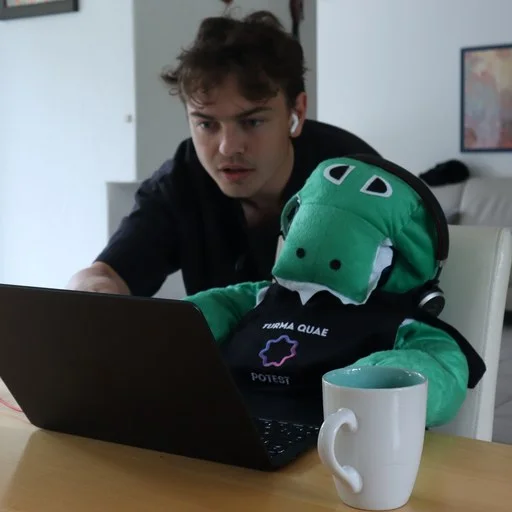
I stopped editing videos because it took too long. Here's the Claude setup that brought me back.
How I gave Claude 782 tagged clips, my Final Cut habits, a sound bank it can read and 227 of my own rules, and went from 2 to 4 hours per reel to under an hour for a concept and all its versions.
Hey!
My name is Lambert. I run growth at Kai, and I’ve loved editing videos since I was 16.
Today I edit our reels with Claude. This is the setup behind it: how Claude learned our 782 clips, the way I edit in Final Cut, the beats of our songs and the 227 notes I’ve given it. A reel used to take me 2 to 4 hours. Now a concept and all its versions take under an hour.
The summers I spent editing
At 16 I watched everything Rory Kramer and ThatOneBlondKid put out. Rory’s video for Avicii’s The Nights is his own life cut to the song: cliff dives, car surfing, water-skiing. ThatOneBlondKid’s That Kid On Tour videos with The Chainsmokers (and part 2) were on repeat, and later the Up & Down music video he directed. Fast cuts, the music landing on the exact frame, text that moves with the people in the shot.
I wanted to make that. So I spent my summers trying.
Then I stopped. Getting the result I had in my head took way too much time, and I never had enough of it.
Kai brought it back, and it still took too long
This year we started filming everything we do at Kai: hackathons, demos, the kitchen, the pool. By May we had a real bank of footage, so I tried again.
The intro video for David, our CEO, took three months from script to shoot to edit. The edit alone took a month and a half.
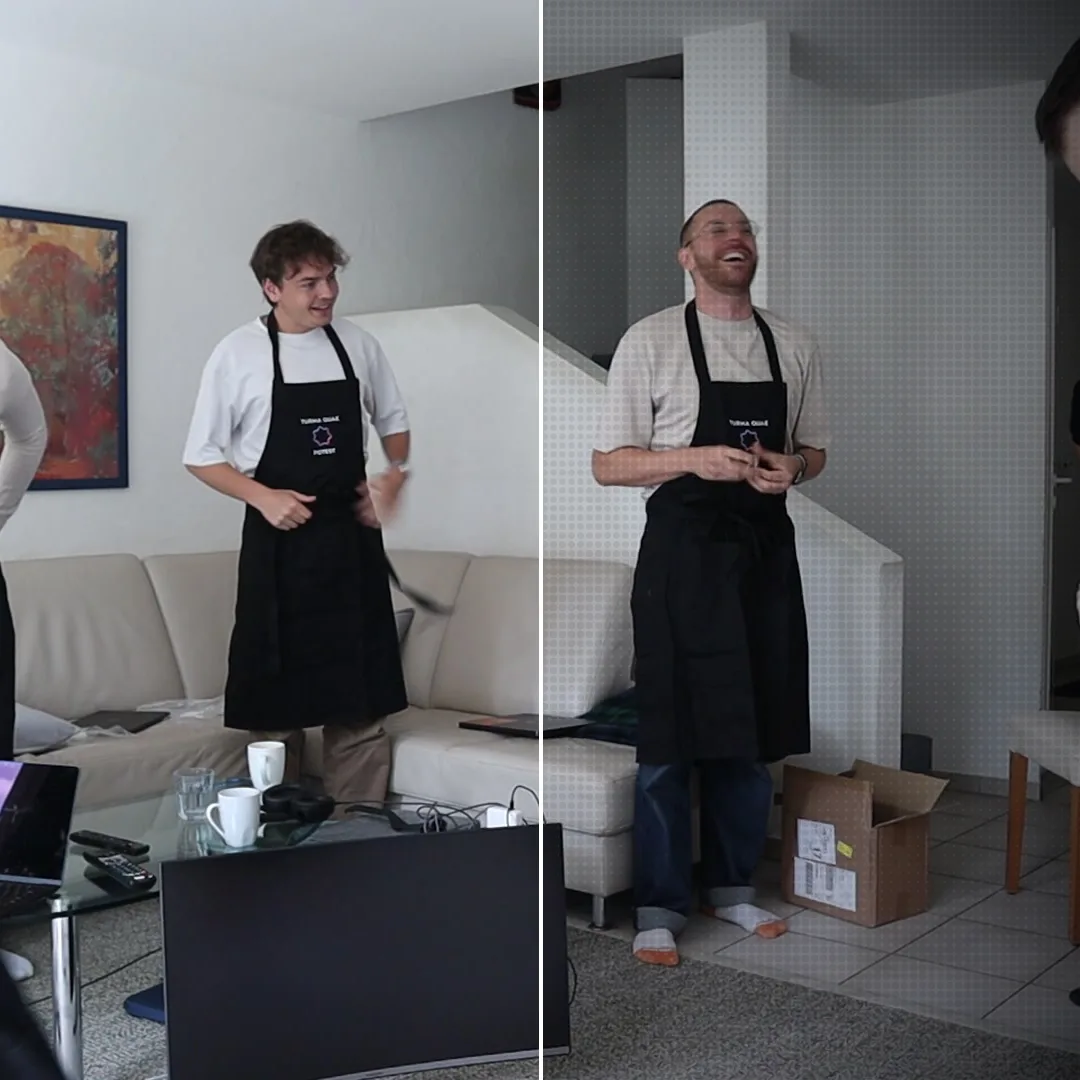
Even a simple reel, like our POV of building a startup with the boys in Switzerland, took me 2 to 4 hours. And that one has almost no editing in it: find the shots, pick the music, put them on the timeline, add the text.
In a startup, 3 hours for a reel you’re not even sure will work isn’t doable. So I parked it again.
End of September: “improve it”
At the end of September I gave Claude an old edit of mine and literally typed: improve it.
I watched what came back and I was like, “Wait… it can do THAT?”
I’M EDITING AGAIN!
Well, almost. Next I gave it a reel I’d saved on Instagram and said: let’s cook something like this with our clips. The edit was great and the clips were wrong. It had no idea what was in our footage, so it grabbed whatever looked close.
Claude could edit. It didn’t know my footage, my taste or my sounds. So I gave it those, one at a time.
Step 1: a bank of real footage, tagged by Claude
We have 782 clips catalogued today, from Zurich in February, Maz in May, Caparica in July and our weeks in Lisbon this fall. They sit in a shared Google Drive.
Claude goes through every clip and writes down what someone would need to find it without watching it: who’s in frame, what they’re doing, where, the light, the energy, the shot size, where there’s room for text, and whether it’s worth keeping. It does that per segment, every time the framing or the action changes.
Here’s a real entry. It’s me, ranting at my AI agent from a rope net in Caparica:
{
  "file": "Lambert-talking-to-claude-2.MOV",
  "start_s": 6.0,
  "end_s": 84.0,
  "who": ["lambert"],
  "action": "working-laptop",
  "place": "house",
  "light": "day",
  "energy": "hype",
  "shot": { "size": "medium", "angle": "high", "camera": "handheld" },
  "text_space": ["top"],
  "keep": "yes",
  "moment": "Lambert argues out loud with his AI agent from the rope net, hands chopping the air"
}
So when I ask for “me working, high energy, room for a title at the top”, Claude knows which 78 seconds to pull.
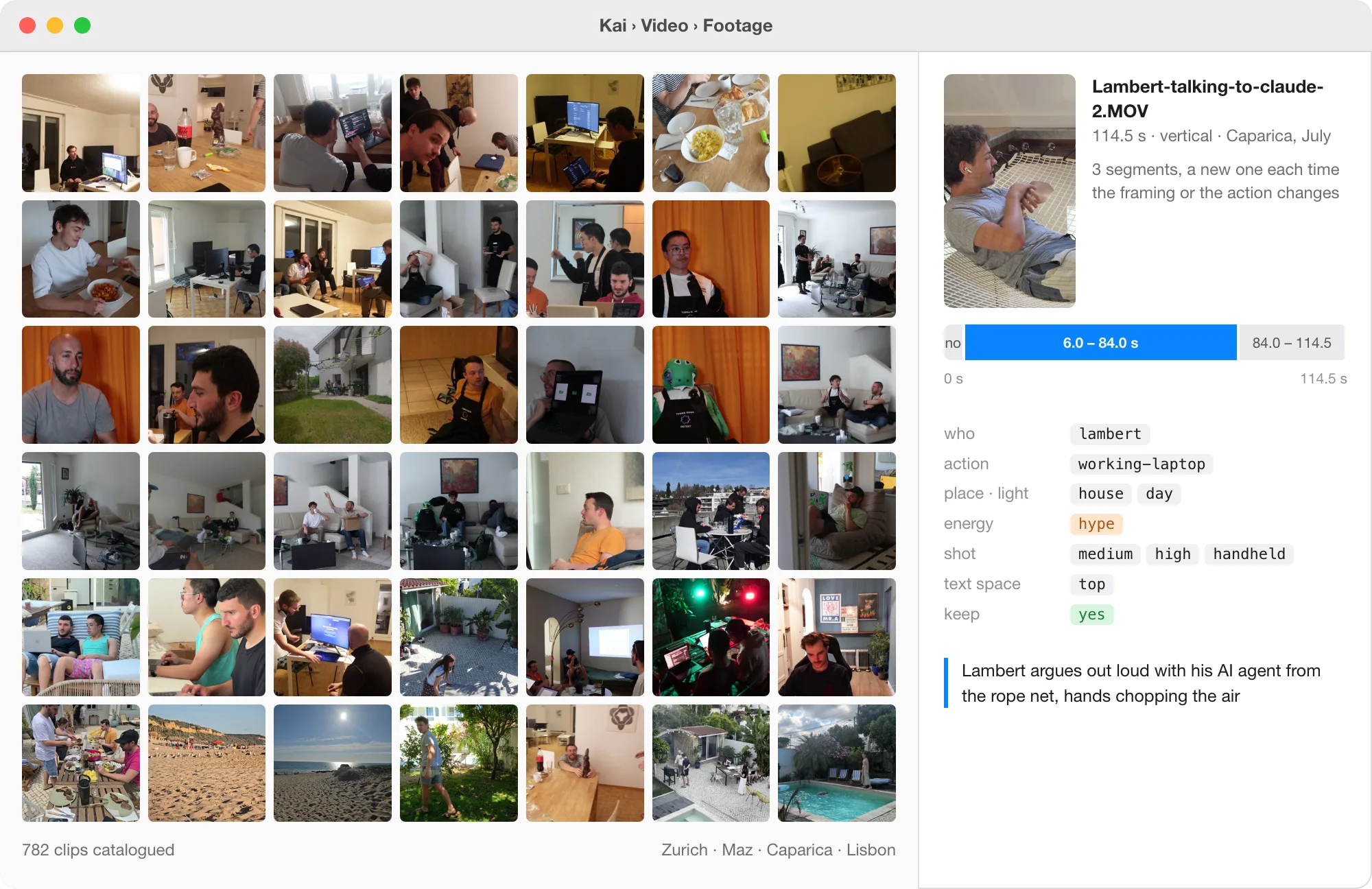
When it picks a shot I don’t want, I say no and the shot goes on a reject list it checks before every edit. 14 shots are on it today.
Why I don’t generate clips
You can generate clips with AI now. For content about you or your company, I think that’s a mistake.
People follow humans. That’s why building in public works for a company: people watch real people cooking, arguing and shipping, and they decide they like you long before they need your product.
So every frame in that bank is one of us.
Step 2: give Claude the edits that already worked
My taste was already sitting in Final Cut: years of projects, the titles I always reach for, my filter, my sound effects.
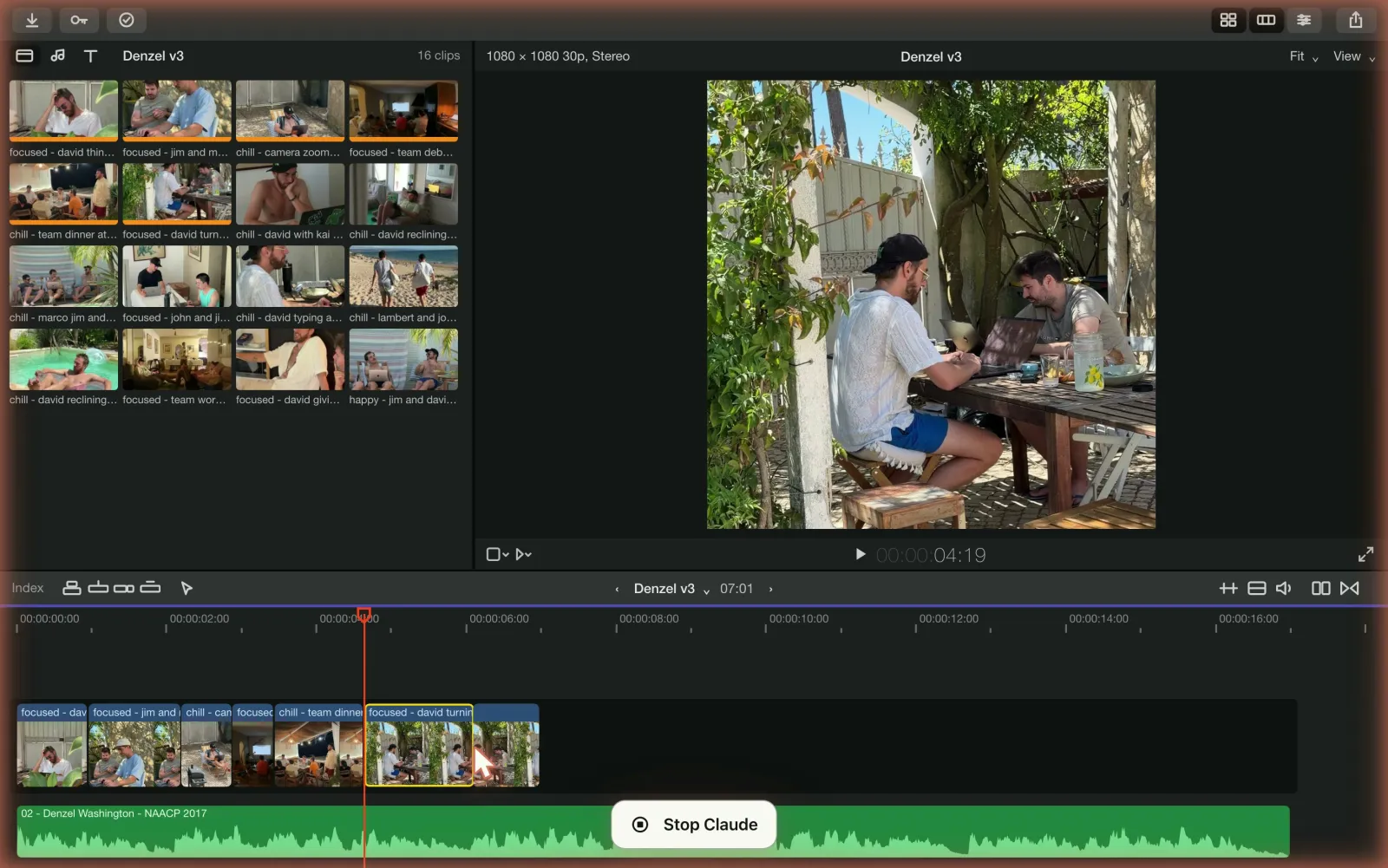
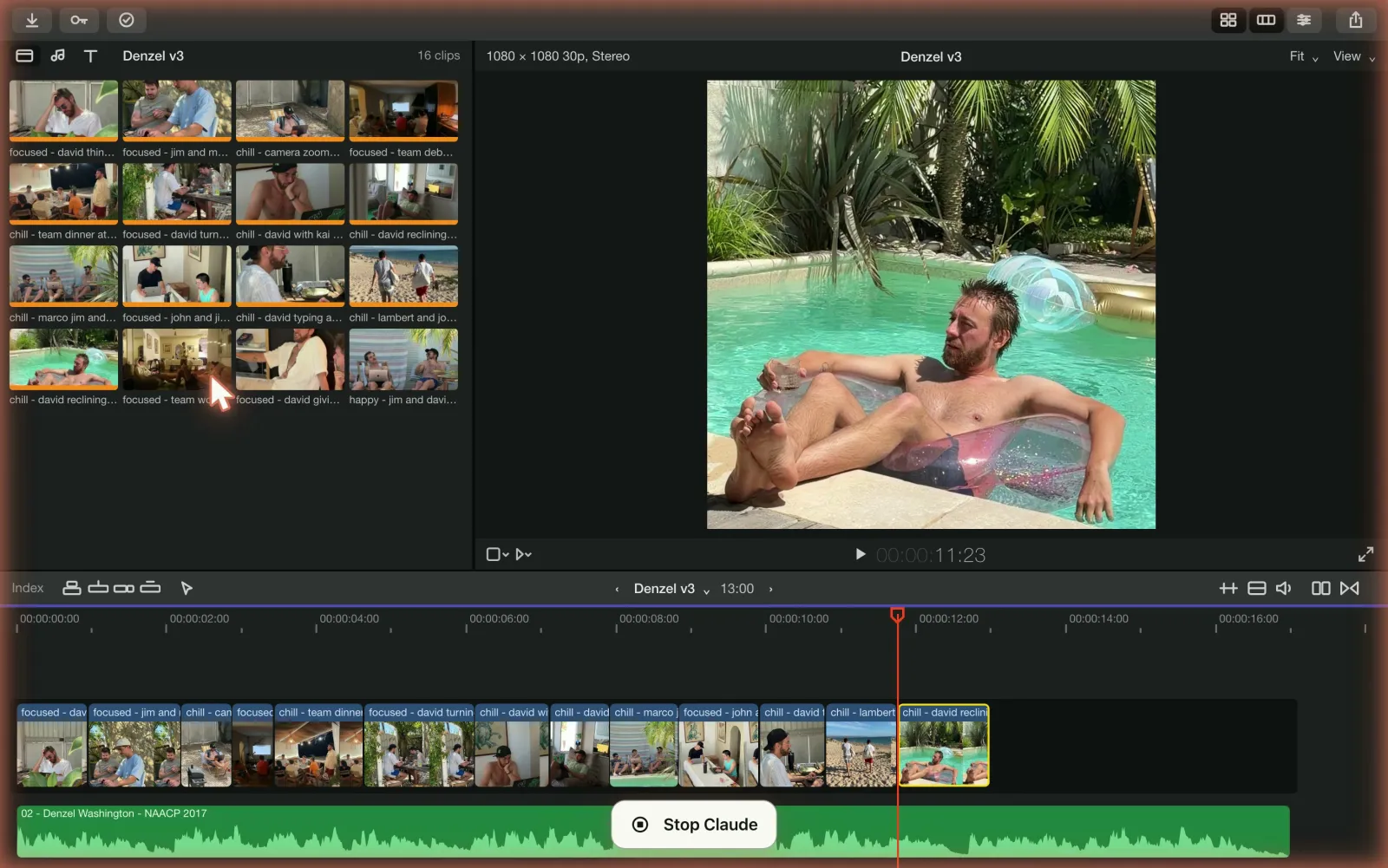
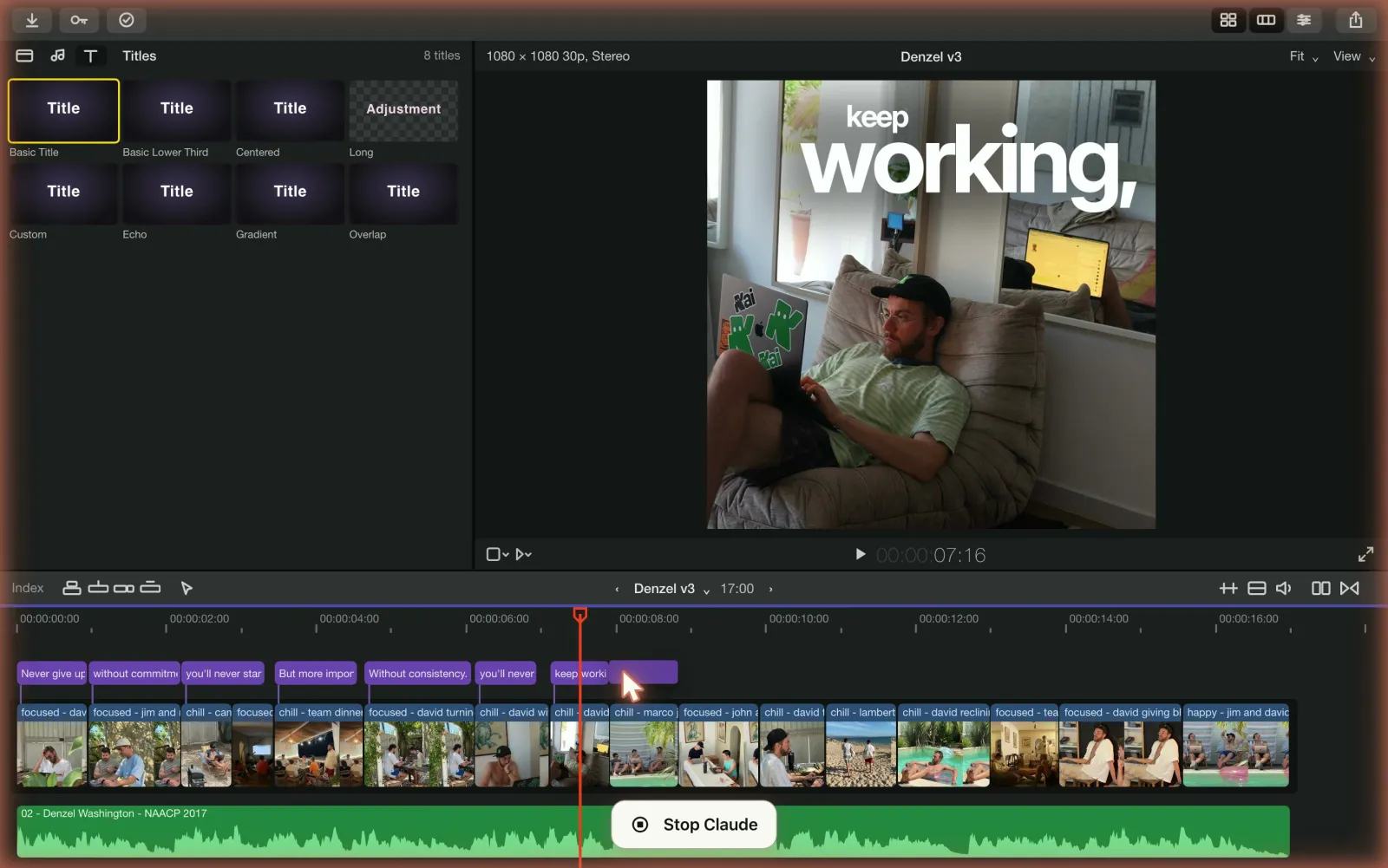
So I let Claude read my projects. It doesn’t click around in Final Cut. It reads the project files, writes down what I do, and renders the edit itself with code.
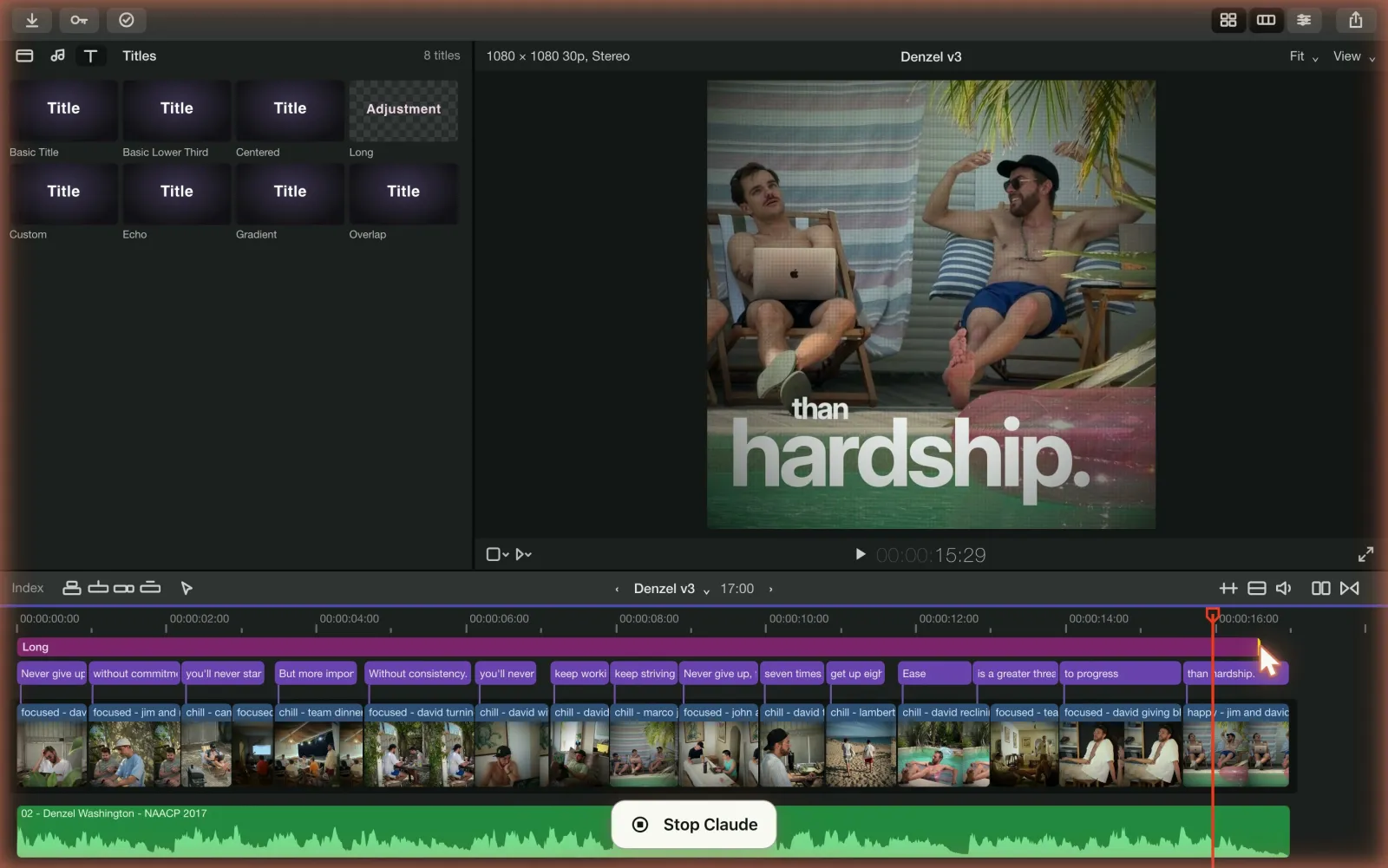
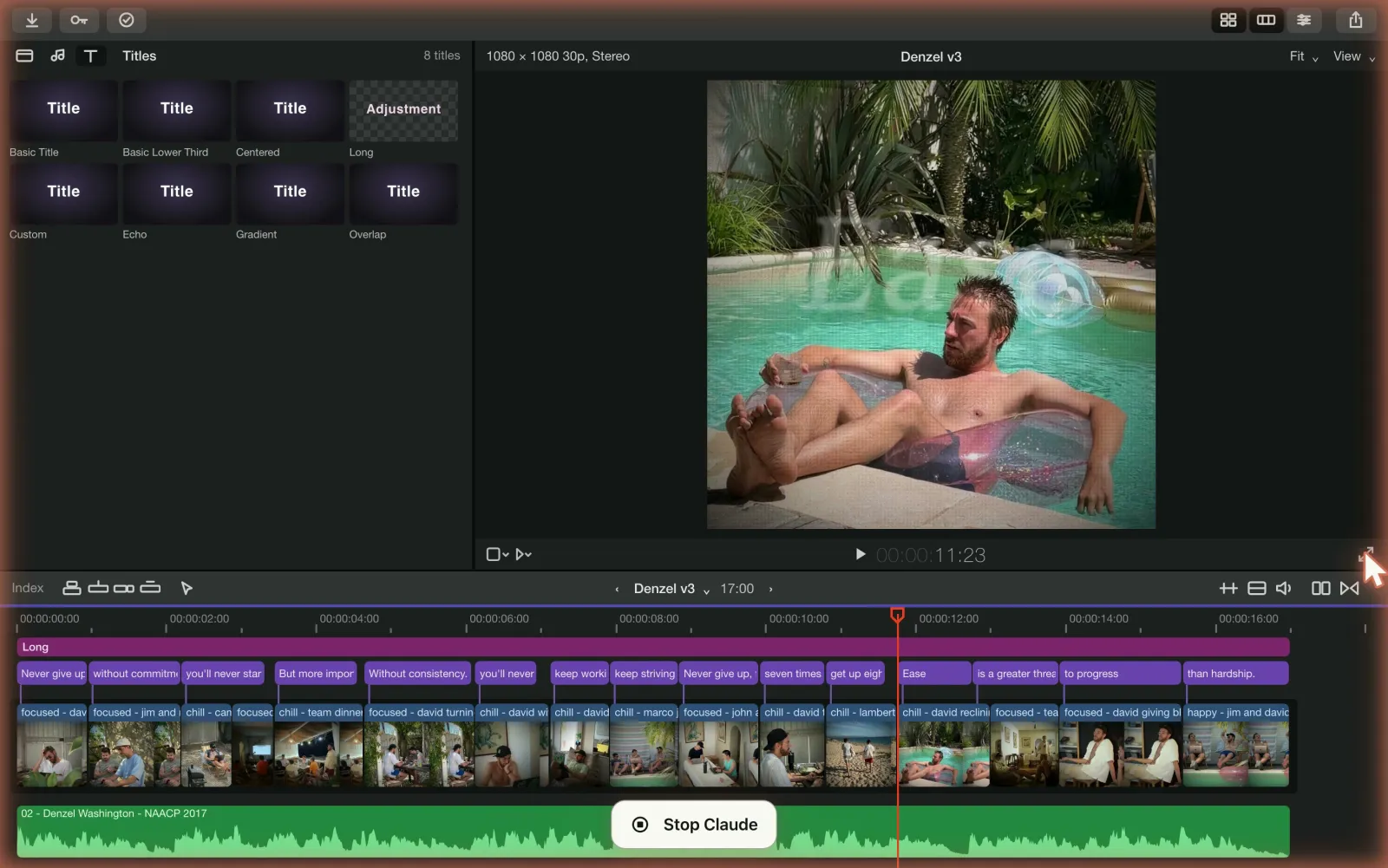
Here’s what it found in one project, the third version of David’s intro:
- 116 titles, almost all in Arial Bold, most of them at size 60.
- 109 of those titles with the same blur-in effect.
- One full-length layer I’d named “Long”: a faint Newsprint halftone with a vignette on top. That’s my look, and it now goes over every reel.
- A half-second shutter click I place 15 to 22 times per video. In that project, 16 of the 22 land within 2 frames of a caption word appearing.
I’d never noticed that last one. I just did it.
Step 3: a sound bank Claude can read
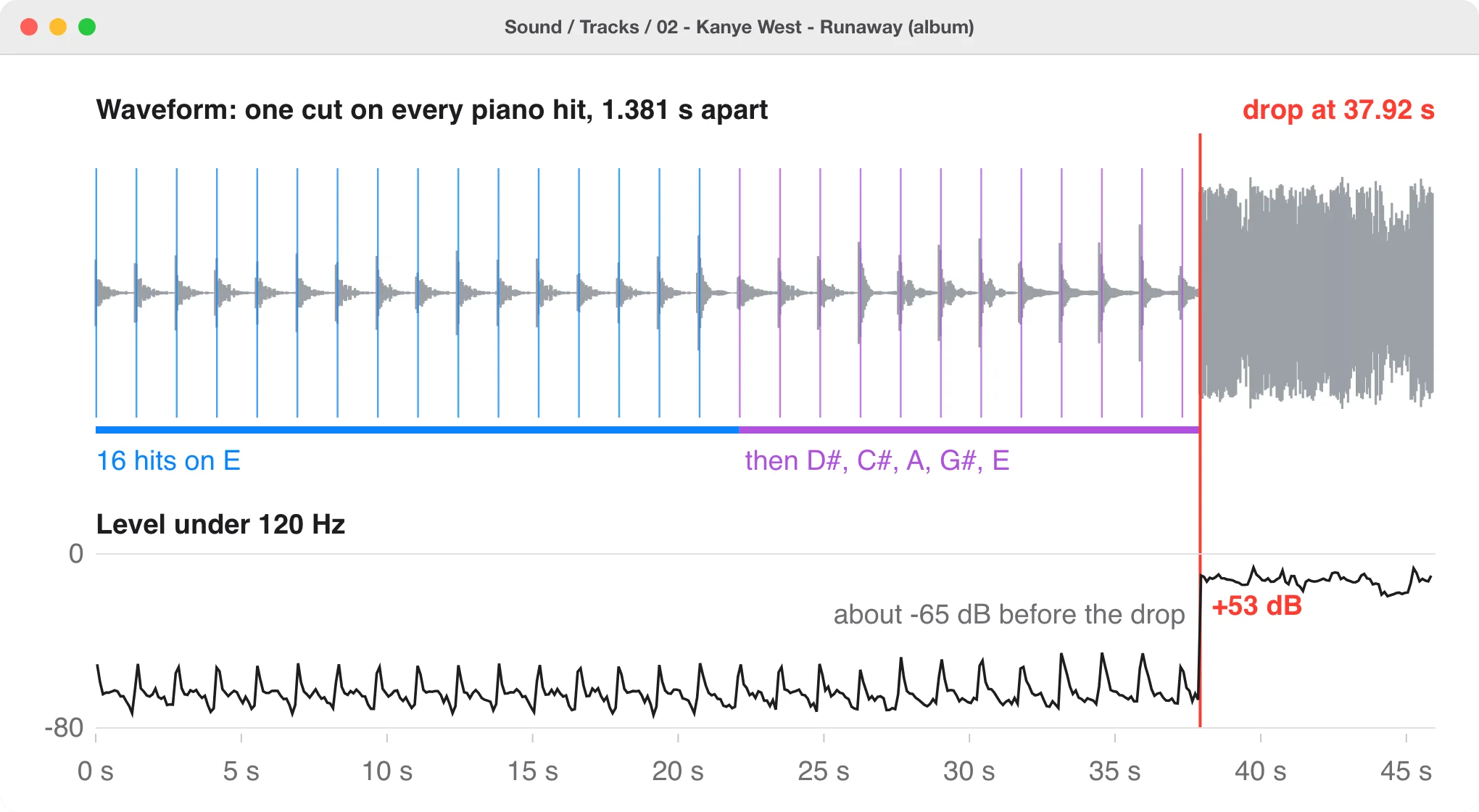
Music is half the edit, so every track lives in a bank with its measurements. Each one starts on its first sound, and its beats are measured on the audio, not by ear. In Runaway (yes, the Kanye one), the piano hits land every 1.381 seconds and the drop is a jump of more than 50 dB below 120 Hz. Claude cuts on those numbers.
Speeches work the same way. When a reel runs on a famous speech, every word has a timestamp, and every new sentence gets a new shot.
Step 4: a skill that asks the right question at the right time
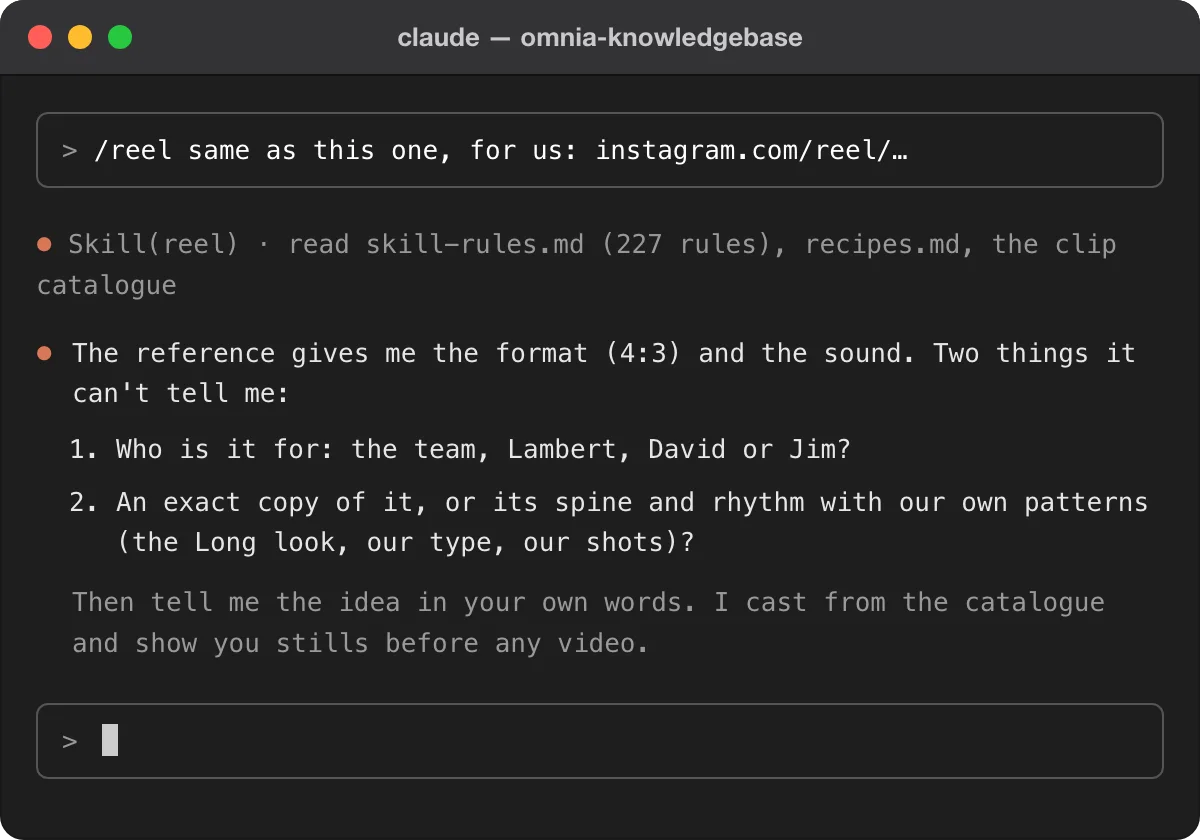
All of this lives in one Claude Code skill. When I start a video, it asks only what it can’t guess: who it’s for, which format, what carries it (a track, a famous speech or one of us talking) and, when I give it a reference, whether I want an exact copy or only its rhythm.
Then I describe the idea. I open Wispr Flow and talk for about 10 minutes: the concept, the moments, the feeling I want at the end.
Every note becomes a rule
This is what takes the most time, and it’s why the rest works.
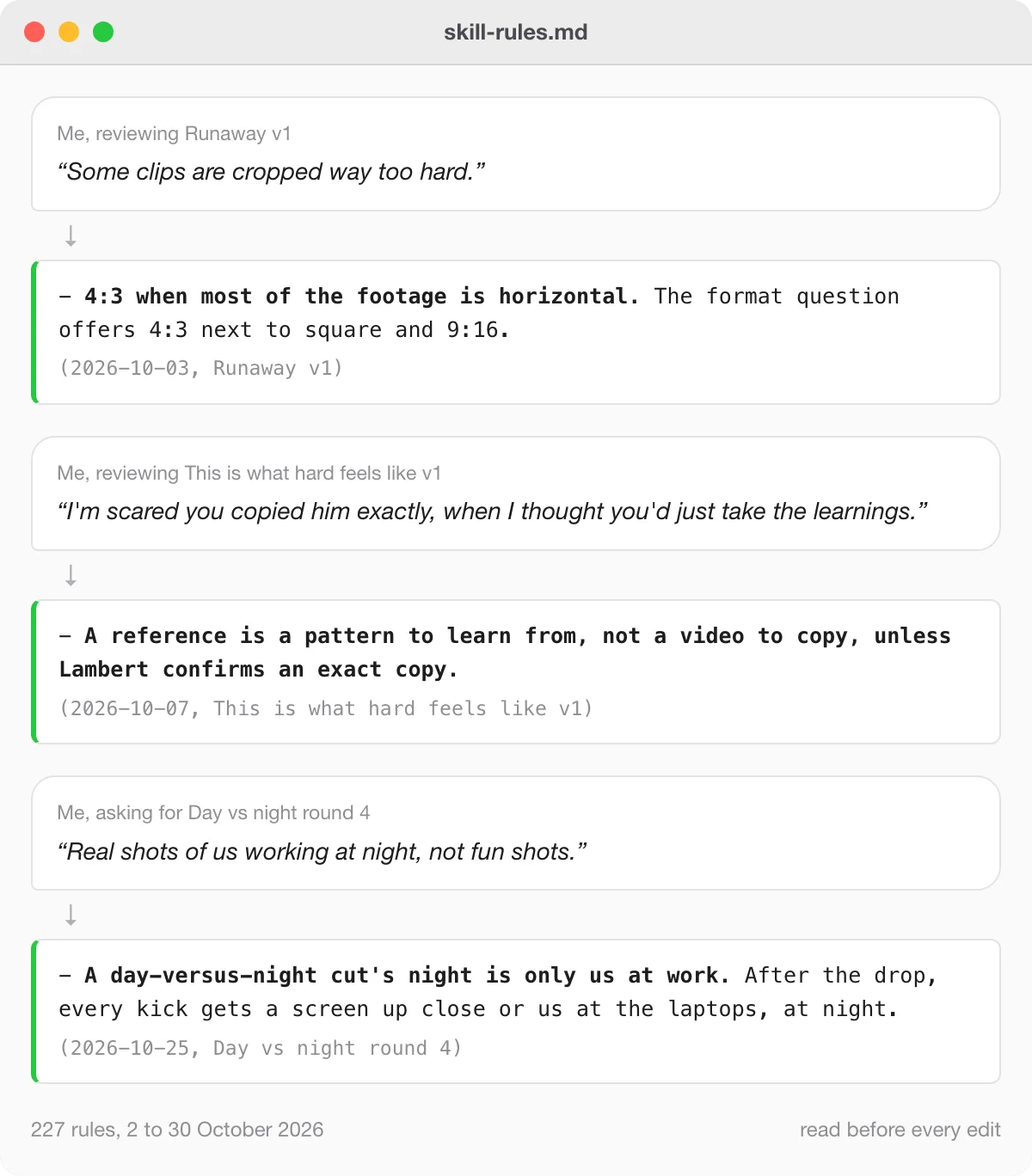
Every time I correct a video, the correction becomes a dated rule in a file Claude reads before every edit. There are 227 of them, written between 2 and 30 October.
One example. I asked for a reel in the format of someone else’s video, and v1 copied his 35 cut times, his fisheye vignette and his type. My note: “I’m scared you copied him exactly, when I thought you’d just take the learnings.”
The rule it wrote: “A reference is a pattern to learn from, not a video to copy, unless Lambert confirms an exact copy.” Now it asks me once, every time.
That’s where your own expertise comes in. Claude can edit. It can’t know that you hate a slow pace, or that your captions breathe after a pause, until you tell it and it writes it down. Every one of the 227 rules started with me watching a version and saying what was off.
What it still gets wrong
It still picks the wrong shot sometimes. I say no, and the list grows.
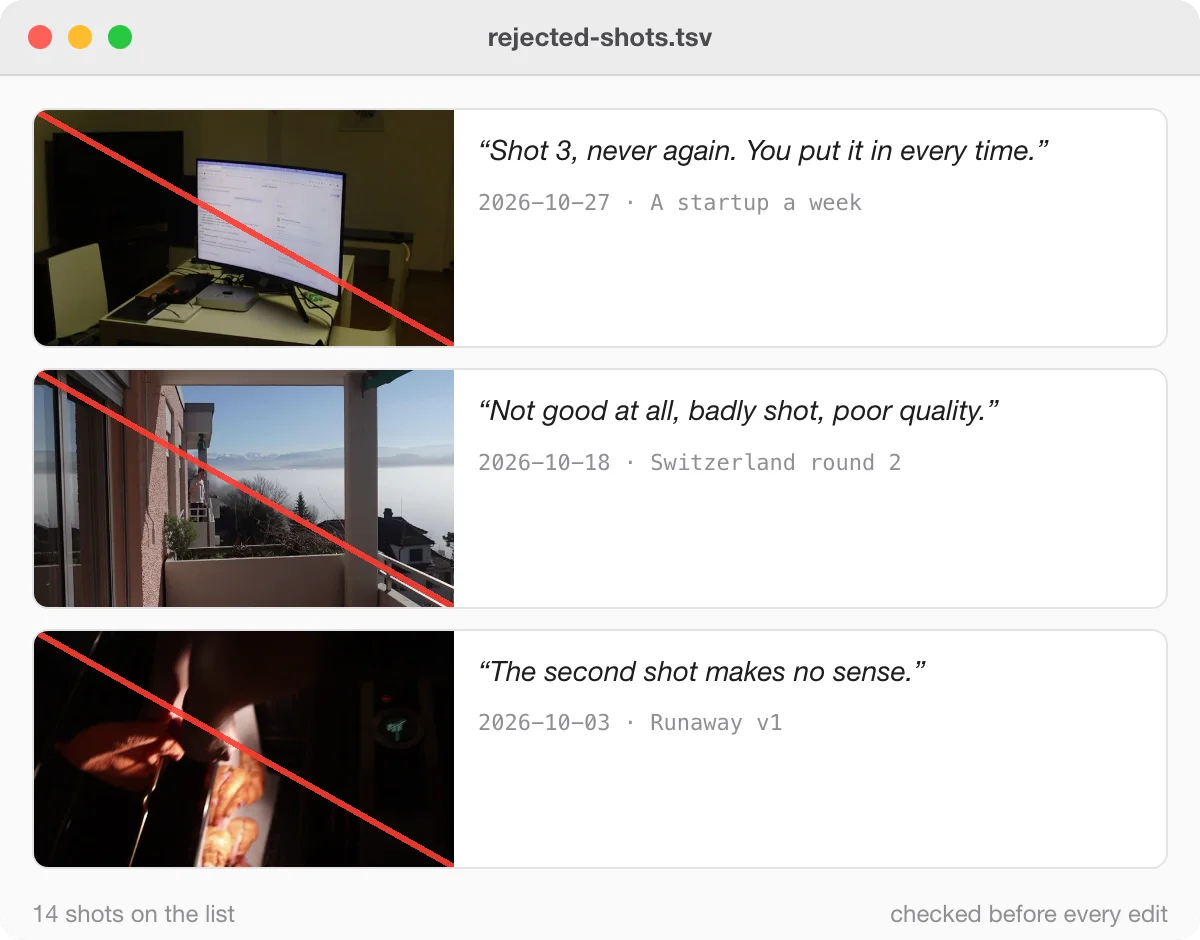
It’s not great at emotion. It can tell a laugh from a frown, but it can’t always tell which laugh makes you feel something. So I watch every version before anything goes out.
And some ideas just die. Claude’s first rebuild of David’s intro reordered my lines and slowed everything down. The rhythm was gone. A reel called Make It Harder got dropped after 5 versions.
Where I am now
A simple reel used to take me 2 to 4 hours. Now a concept with several versions takes 30 minutes to an hour, and 10 of those minutes are me talking into Wispr Flow.
What happens after the edit (testing several versions of each idea on Instagram and reading where people stop watching) is the next article. Jim and I talked about it in How We Grow #018.
If you’ve got a folder of footage, start where I started and get Claude to tag it. The “Run this playbook with Claude” button at the top of this page sets up the same system around your footage, your edits and the way you review :)
Then tell me how it went on LinkedIn. I read every single message!